
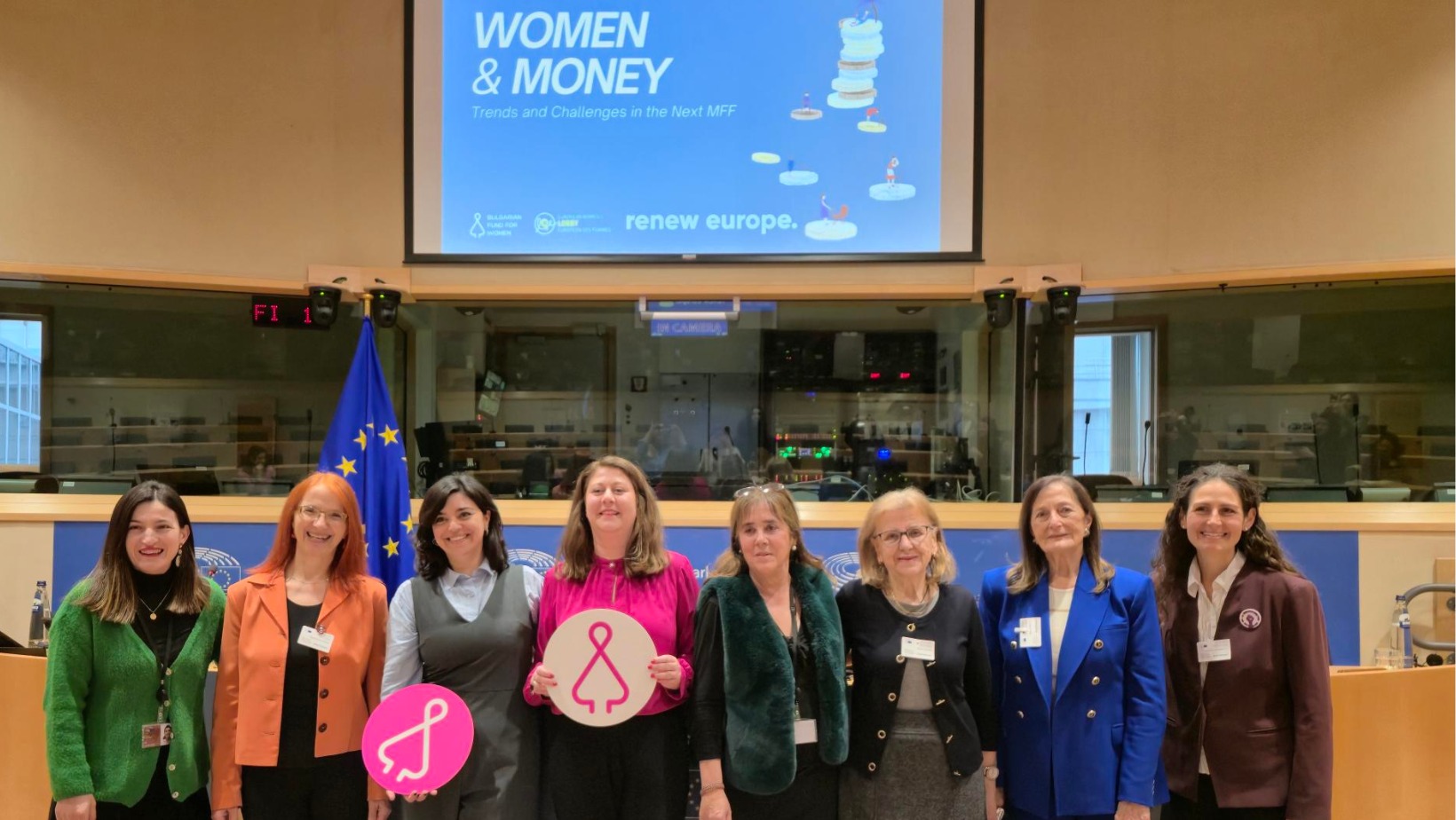
Currently, the European Parliament, European Commission (EC) and European Council are negotiating the European Union’s (EU) next Multiannual Financial Framework (MFF), that is the EU’s budget for 2028-2034. Both the Gender Budget Watchdog Network (GBWN) and the European Gender Budget Network(EGBN) have expressed concern regarding the extent to which the draft MFF and accompanying Financial Regulation put forth by the EC sufficiently commit to clear outcomes, indicators, and budgetary allocations to deliver on EU commitments to furthering gender equality as an EU fundamental value. The MFF and its accompanying regulations are of significant importance because they will shape the financing available for furthering gender equality, safeguarding civil society, and supporting women’s rights organisations in the future.
On behalf of GBWN and EGBN, Nicole Farnsworth, Deputy Director and Lead Researcher at the Kosovo Women’s Network (KWN), joined other EGBN members in Brussels last week to coordinate advocacy efforts with other civil society organisations (CSOs) and coalitions. They met with members of the European Parliament Alexandra Geese, Tomas Waitz and Ilhan Kyuchyuk, seeking their support in gender mainstreaming the EU budget.
Farnsworth also met with EC representatives regarding the Western Balkan (WB) Enlargement Package, asking for gender-responsive budgeting to be implemented as part of Reform Agendas across the WB, including in the EC’s direct budget support to governments. This would be in line with commitments to accountability and the rule of law, given WB governments’ commitments to implementing gender-responsive budgeting as part of the Sustainable Development Goals, among other legal commitments.
On 4 December, Nicole attended the annual WB Summit hosted by Friends of Europe. During discussions on economic growth, she emphasized that growth cannot happen without women; women’s labour force participation is low throughout the WB. “If we really want to see growth, we need to get women [in the labour force]”, said Farnsworth. She called for integrating gender-responsive budgeting in all EU investments, towards addressing root causes of low labour force participation. Research evidences that this includes transforming unpaid labour into paid labour by tackling informality, establishing care services, and improving transportation, as GBWN research shows.
Farnsworth acknowledged existing critiques of terminology like “gender-responsive budgeting”. She deconstructed the sometimes-misunderstood term, emphasising how it simply entails analysing problems and setting objectives to address them with indicators to measure progress. “It’s just good project planning,” she said. A clear case in point is labour force participation, which can contribute to growth, but only if key obstacles to women’s participation are identified and addressed by investments.
Towards joining forces with other coalitions, Farnsworth also met with the Civil Society Europe Working Group on Funding,Concord, Alliance for Gender Equality in Europe,ODI Europe “Walking the Talk” Initiative, and Prospera on behalf of GBWN and EGBN to discuss opportunities for collaboration towards shared aims. “We believe strongly in networking,” Farnsworth said during an event co-organised by the European Women’s Lobby and Bulgarian Women’s Fund. “We realised long ago that things happening on an EU and global level affect us and our work, but we cannot influence these policies alone. We need to work together with other networks and alliances to bring about changes.”
Stay tuned for upcoming GBWN and EGBN advocacy campaigns where we hope to join forces with other organisations and individual citizens globally to call for an MFF that invests in what matters in people’s lives!
