
Climate finance is not gender-neutral. The way investments are planned, allocated and implemented determines not only how effectively countries respond to climate change, but also who benefits from the green transition.
On 11 and 19 November 2026, the Gender Budget Watchdog Network (GBWN) organised a two-part webinar series on Monitoring Climate Financing from a Gender Perspective, bringing together climate finance experts, researchers and civil society representatives to examine how gender equality is reflected in international climate finance mechanisms and green investments across the Western Balkans and Moldova.
The discussions explored an essential question: Are climate investments reaching everyone, and are they responding to the different needs, priorities and realities of women and men?
While countries across the region are mobilising significant resources for climate action, environmental protection, sustainable infrastructure and transport, the integration of gender equality into these investments remains an important area for scrutiny. Financial commitments alone do not guarantee inclusive outcomes. Understanding who benefits from climate finance requires looking beyond the total amounts invested and examining how priorities are established, how funding is distributed and whether gender considerations translate into concrete results.
Understanding gender equality in international climate finance
The first webinar, held on 11 November, focused on how major international climate finance mechanisms integrate gender equality into their funding frameworks, investment decisions and implementation processes.
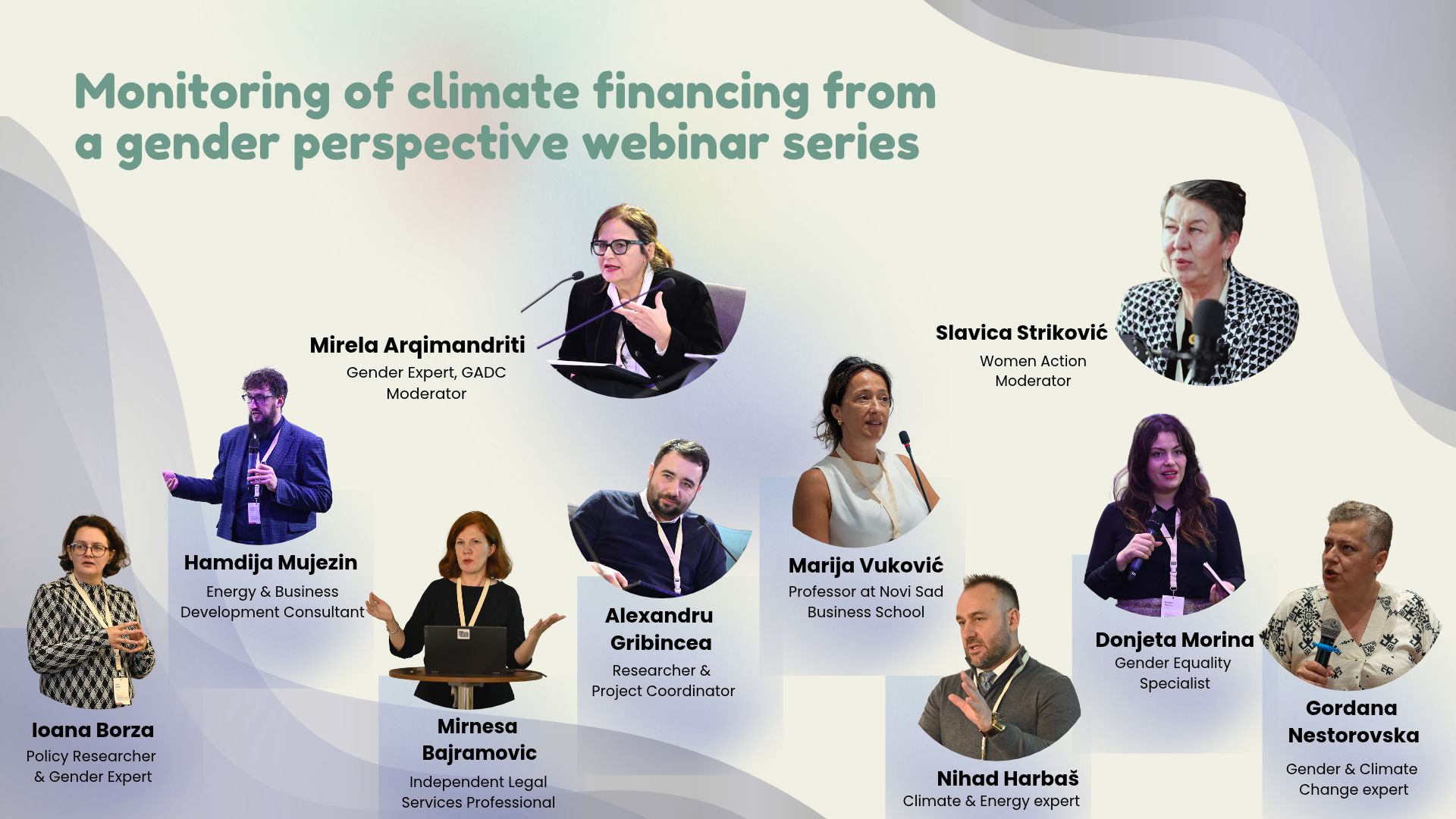
- Donjeta Morina – A Watchdog Analysis of the Special Climate Change Fund in the Western Balkans and Moldova
- Nihad Harbas – Gender Budget Watchdog Report of Planned and Executed Funds in the Green Climate Fund (GCF)
- Marija Vukovic – Report on Planned and Executed Funds in EIB Projects in The Western Balkans And Moldova
- Gordana Nestorovska – Assessment of readiness for the Belém Gender Action Plan in the Western Balkans and Moldova
Moderated by Slavica Strikovic from Ženska Akcija, the discussion highlighted the importance of moving beyond the formal recognition of gender equality in climate policies towards its meaningful integration throughout the entire climate financing cycle.
This includes ensuring that gender analysis informs project design, that women and women’s organisations can participate in decision-making, and that investments are monitored against clear gender equality objectives.
Following the money: What do green investment figures reveal?
The second webinar, held on 19 November, shifted the focus from international funding frameworks to the actual allocation and implementation of green investments across the region.
Drawing on GBWN’s regional gender budget watchdog research, four experts presented findings from studies examining major investment programmes and sectors:
- Ioana Borza – Planned and Executed Funds in EBRD Green Projects in the Western Balkans and Moldova
- Hamdija Mujezin – Planned and Executed Funds in the Western Balkans Investment Framework
- Mirnesa Bajramovic – Analysis of Global Environment Facility (GEF) Projects in the Western Balkans and Moldova
- Alexandru Gribincea – Regional Transport Analysis from a Gender and Climate Financing Perspective
Moderated by Mirela Arqimadriti from GADC, the discussion examined what public investment data can tell us about the gender responsiveness of green projects, including the relationship between planned and executed funding and the extent to which gender equality considerations are reflected in investment priorities.
The research provided an important basis for questioning whether the green transition is addressing existing inequalities or potentially reproducing them through investment decisions that overlook different needs and experiences. Monitoring these investments is therefore essential to understanding not only how much money is being spent, but also what outcomes that spending is expected to deliver and for whom.
From monitoring to accountability: The role of civil society
A central message emerging from both webinars was the importance of strengthening civil society’s role in monitoring climate finance and holding institutions accountable for their commitments to gender equality. By analysing budgets, tracking financial allocations, examining project implementation and assessing policy commitments, civil society can generate evidence that connects public spending with people’s lived realities. This work helps identify gaps between policy commitments and financial decisions, between planned and executed investments, and between the stated objectives of green projects and their actual attention to gender equality. Additionally, it also creates opportunities for constructive dialogue with governments, international financial institutions and development partners, advocating for more transparent, inclusive and accountable climate financing systems.
Making the green transition work for everyone
The two webinars reaffirmed that climate finance must be assessed not only through the scale of investments or the number of projects delivered, but also through their contribution to a more equal and sustainable society. As countries in the Western Balkans and Moldova advance their green transition, gender-responsive planning, budgeting and monitoring must become an integral part of climate action rather than an additional consideration.
Because the question is not simply how much we invest in the green transition, but whose priorities shape those investments and who ultimately benefits from them.
Through its regional monitoring work, GBWN continues to support civil society organisations in strengthening their capacity to follow climate finance, generate evidence and advocate for public investments that are transparent, accountable and responsive to gender equality.
Explore the regional research and monitoring findings:
Monitoring of Climate Financing – Gender Budget Watchdog Network
