Gender-responsive budgeting is not simply about allocating funds for women. It is about ensuring that public resources respond to the different needs of women and men, reduce inequalities and contribute to more inclusive and sustainable development.
In June 2026, experts from the Gender Budget Watchdog Network (GBWN) delivered a two-day online capacity-building workshop for civil society organisation (CSO) representatives from across Africa, focusing on Gender-Responsive Budgeting (GRB) and the watchdogging of climate change financing.
The workshop aimed to strengthen civil society’s capacity to understand, analyse and monitor public budgets and climate-related financial resources from a gender equality perspective. It equipped participants with practical knowledge and tools to assess whether government policies, budget allocations and public expenditure reflect the different needs, priorities and lived realities of women and men.
Connecting gender equality with public finance
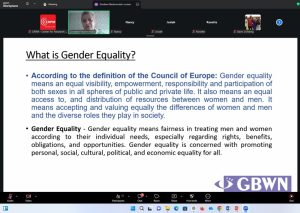
The first day focused on the foundations of gender equality, gender mainstreaming and public policy, exploring how gender perspectives can be integrated throughout the policy and budget cycles.
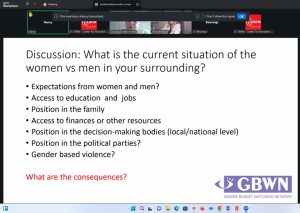
Participants examined how government budgets translate political commitments and policy objectives into financial decisions, and why these decisions matter for gender equality. The sessions explored practical questions such as whether women’s and men’s needs are equally recognised in policy planning, whether they have equal opportunities to participate in decision-making, and whether public resources and services benefit them equitably.
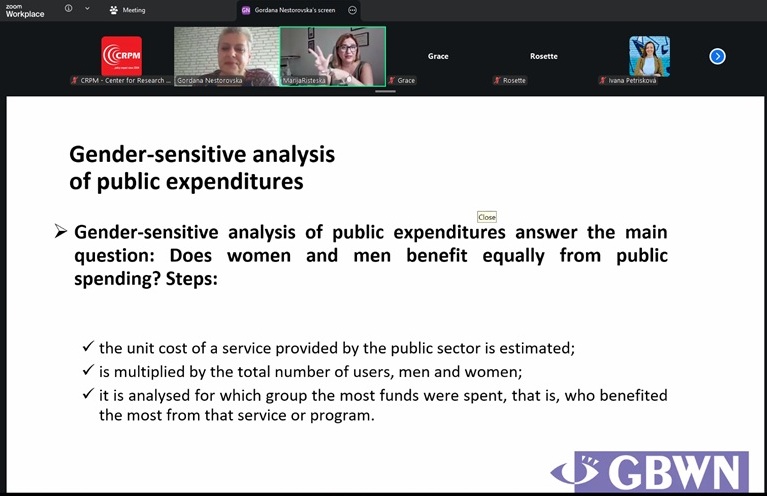
Particular attention was given to the practical application of gender-responsive budgeting tools, including gender analysis of policies, beneficiary assessments, analysis of public expenditures and revenues, and gender-based cost-benefit and cost-effectiveness analysis.
Through interactive discussions and group exercises, participants explored real-life policy examples, including agricultural policies and women’s access to land, the distribution of public resources, access to public services and the gender implications of taxation.
Bringing a gender perspective into climate finance
The second day focused on gender-responsive budgeting methods and the monitoring of climate change financing.
Recognising that climate change does not affect everyone equally, GBWN experts explored how existing gender inequalities, socio-economic circumstances and unequal access to resources shape people’s vulnerability to climate risks and their capacity to adapt.
Participants discussed the importance of ensuring that climate policies and investments address the specific needs of women, men and vulnerable groups, rather than treating communities as homogeneous. Topics included women’s access to renewable energy, climate-resilient agriculture, green jobs, climate information, early warning systems and disaster preparedness.
A central component of the training was the practical framework for integrating gender considerations throughout the climate policy cycle:
- Needs assessment: Using gender statistics, gender analysis and stakeholder consultations to identify differentiated climate vulnerabilities and priorities.
- Planning: Establishing gender-sensitive indicators, integrating gender-responsive budgeting and ensuring that climate investments address existing inequalities.
- Implementation: Strengthening institutional capacities, promoting equal participation and ensuring that climate interventions reach their intended beneficiaries.
- Monitoring and evaluation: Applying gender audits, monitoring the utilisation of climate funds and assessing whether climate investments deliver equitable benefits.
Participants also worked on identifying entry points for civil society organisations to monitor climate financing, from the identification and planning of climate initiatives to their implementation and evaluation.
Civil society as a watchdog for accountable climate finance
An important message throughout the workshop was that monitoring climate finance requires looking beyond the amounts allocated and spent. It also requires asking who participates in decisions, who receives the benefits, whose priorities are reflected in investments and whether public resources contribute to meaningful and lasting change.
Through practical group work, participants explored how civil society can use gender-disaggregated data, gender indicators and budget analysis to assess the impact of climate-related policies and investments. They also discussed how monitoring findings can inform advocacy and strengthen public accountability.
The workshop reinforced the importance of moving beyond measuring participation alone towards assessing actual changes in people’s lives, including women’s access to productive resources, economic opportunities, climate-resilient services and decision-making spaces.
Advancing the 2030 Agenda through inclusive public finance
By strengthening the knowledge and practical capacities of civil society representatives from across Africa, the workshop contributed to advancing the values and objectives of the United Nations and the 2030 Agenda for Sustainable Development.
Its focus directly supports SDG 5 (Gender Equality), SDG 13 (Climate Action) and SDG 16 (Peace, Justice and Strong Institutions), while reinforcing the importance of effective, transparent and inclusive financing for sustainable development.
Through GBWN’s expertise and regional experience in gender-responsive budgeting and climate-finance monitoring, CRPM continues to promote the role of civil society as an essential actor in ensuring that public resources translate into more equitable policies, stronger institutions and climate-resilient communities.
Because climate finance must not only reach its intended destination — it must also deliver equitable benefits and leave no one behind.